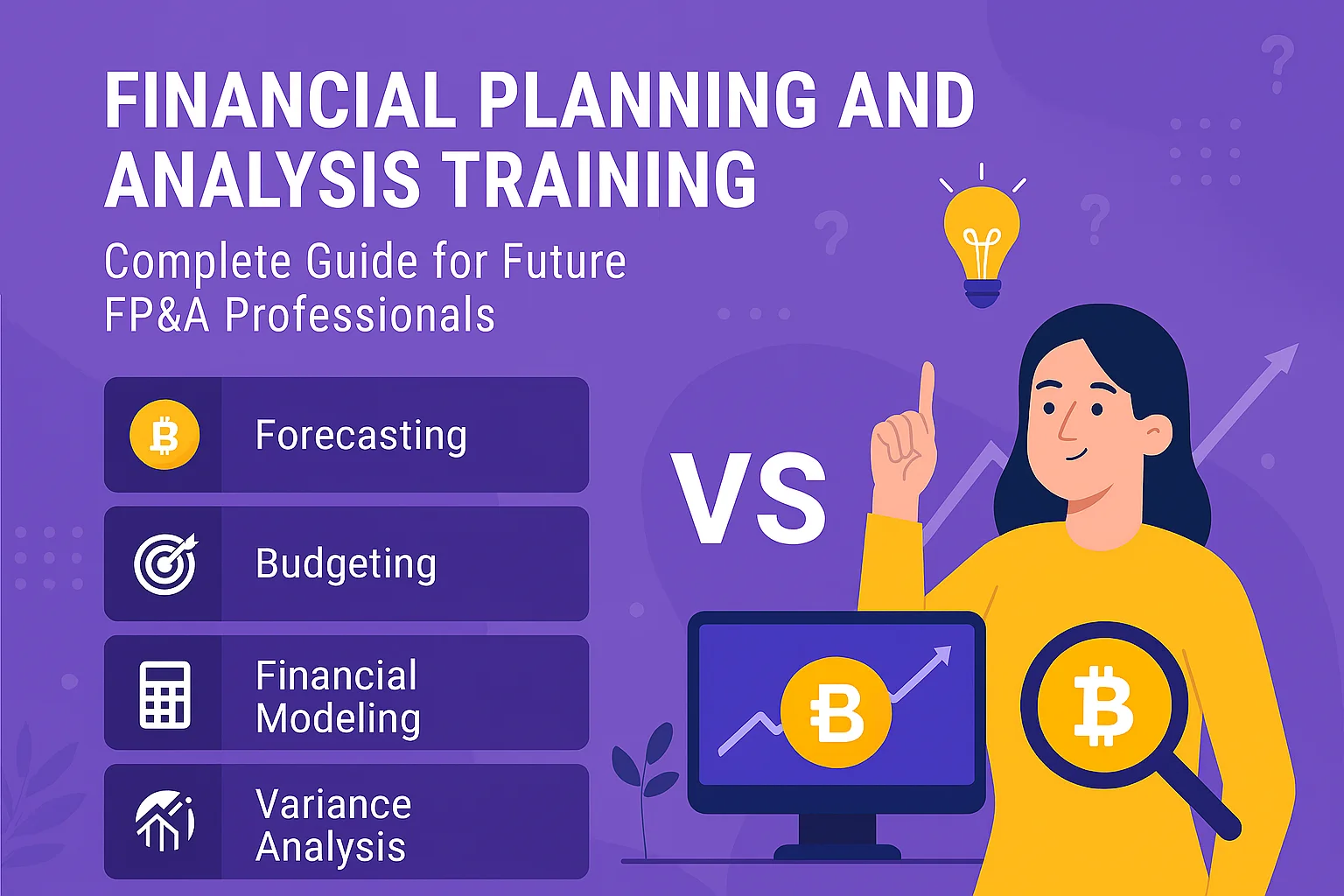
Financial Planning and Analysis Training is one of the most valuable pathways for anyone aiming to build a career in finance, business planning, or strategic decision-making. FP&A professionals analyze company performance, create budgets, forecast financial trends, and support business strategy with data-driven insights.
Because companies rely heavily on financial forecasting and performance tracking, FP&A skills are in high demand across industries—from tech and banking to retail and manufacturing.
This complete guide explains what FP&A training includes, skills you will learn, career opportunities, and why this field is essential in today’s business world.
What Is Financial Planning and Analysis (FP&A) Training?
FP&A training is a structured program that teaches learners how to:
- Develop annual budgets
- Create monthly or quarterly forecasts
- Analyze financial performance
- Prepare management reports
- Conduct variance analysis
- Support strategic decision-making
- Understand financial statements deeply
- Use Excel and modeling tools
- Automate reporting and dashboards
The training focuses on real-world business scenarios so professionals can operate confidently in corporate finance environments.
⭐ Table: Core Modules in Financial Planning and Analysis Training
| Module | What You Learn | Why It Matters |
|---|---|---|
| Budgeting | Creating annual budgets, expense planning | Core responsibility in FP&A |
| Forecasting | Revenue, cost, and profit projections | Helps guide strategic decisions |
| Variance Analysis | Comparing actual vs. planned numbers | Identifies risks & opportunities |
| Financial Reporting | Dashboards, management reports, KPIs | Communicates performance clearly |
| Excel for FP&A | Modeling, scenario analysis, automation | Essential technical skill |
| Financial Statements | P&L, Balance Sheet, Cash Flow | Helps understand company health |
| KPI Development | Metrics for performance measurement | Drives business efficiency |
| Scenario Planning | Best, base & worst-case forecasting | Prepares companies for uncertainty |
| Data Visualization | PowerPoint, charts, insights | Improves decision-making |
Why FP&A Training Is Important
FP&A is the backbone of business strategy. Companies rely on FP&A teams to:
- Track financial performance
- Improve profitability
- Identify financial risks
- Plan future growth
- Provide insights to executives
- Guide investment decisions
- Allocate budgets efficiently
Proper training ensures professionals can handle the analytical and strategic responsibilities of the role.
Who Should Enroll in FP&A Training?
This training is ideal for:
- Finance students & graduates
- Accounting professionals
- Aspiring FP&A analysts
- Corporate finance employees
- Business managers
- Investment & portfolio analysts
- Entrepreneurs
- Data analysts shifting to finance
You don’t need to be a finance expert — the training builds all essential skills.
Key Skills You Will Learn in FP&A Training
1. Budgeting & Cost Planning
Learn how to prepare and manage:
- Operating budgets
- Capital budgets
- Department-level cost plans
This is the foundation of FP&A.
2. Forecasting Methods
Master forecasting techniques like:
- Trend analysis
- Regression forecasting
- Rolling forecasts
- Driver-based forecasting
Forecasting is the most critical part of FP&A.
3. Variance Analysis
You will learn how to evaluate:
- Why actual performance differs from planned
- Revenue & cost variances
- Profitability gaps
- Performance trends
FP&A teams use these insights to correct company direction.
4. KPI Development
Learn to track:
- Profit margins
- ROI
- Working capital
- Customer acquisition cost
- Productivity ratios
KPI tracking helps management evaluate success.
5. Advanced Excel for FP&A
Training includes:
- Pivot tables
- SUMIFS, INDEX-MATCH
- Scenario modeling
- Sensitivity analysis
- Dynamic dashboards
Excel is the heart of FP&A work.
6. Financial Statement Analysis
Understand how business decisions impact:
- P&L (Profit and Loss)
- Balance Sheet
- Cash Flow
This skill helps analysts evaluate company health.
7. Financial Modeling Basics
Learn to build:
- Forecasting models
- Consolidation models
- Operating models
These models support strategic decision-making.
Career Opportunities After FP&A Training
Completing the training prepares you for roles like:
- FP&A Analyst
- Senior FP&A Analyst
- Financial Analyst
- Corporate Finance Associate
- Cost Analyst
- Business Analyst
- Budget Analyst
- Finance Manager
- Strategy Analyst
These roles offer high salaries and rapid career growth.
Benefits of Financial Planning and Analysis Training

- Learn real corporate finance skills
- Become job-ready quickly
- Improve your analytical thinking
- Build strong Excel and reporting expertise
- Increase chances of landing a high-paying role
- Understand how businesses operate financially
- Strengthen your resume
- Open global career opportunities
Companies value professionals who can convert data into strategic insights.
Conclusion
A financial planning and analysis training course is a powerful career-building tool for anyone looking to advance in finance or business strategy. It equips you with essential skills like budgeting, forecasting, variance analysis, financial reporting, and Excel modeling — all of which are crucial in building a successful FP&A career.
Whether you’re a beginner or an experienced professional, this training provides the knowledge and tools needed to analyze performance, support strategic decisions, and contribute meaningfully to business growth.